Blocky Highway: Traffic Racing
- 4.2
- Rating
- 50.00M
- Installs
- Free
- Price
 Analysis by App-foxy
I spent time with Blocky Highway: Traffic Racing as a quick, arcade-style driving game, and my first impression was that it understands exactly what kind of experience it wants to deliver. This is not a serious racing simulator, a long-form career game, or a realistic traffic-management challenge. It is a bright, block-shaped road game built around immediate movement, collecting vehicles, and trying to survive another run.
That focus makes it easy to pick up when I have only a few minutes. I do not need to study complicated controls or learn a large collection of racing rules before enjoying it. At the same time, the simple presentation hides a few decisions that matter more than the store summary suggests. The best way to judge it is not by asking whether it replaces a full racing game, but whether its short, repeatable arcade runs fit the way you like to play on a phone.
What the game is really offering
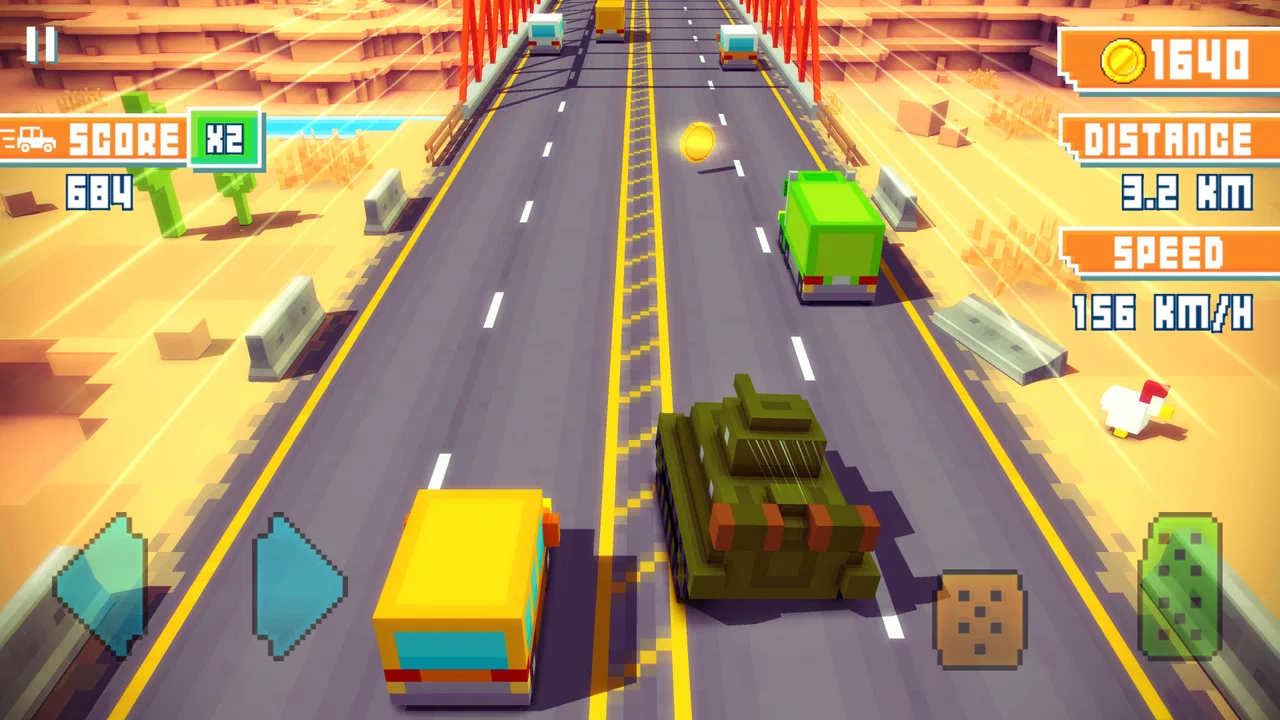
Developed by DogByte Games, this free racing game places the emphasis on navigating blocky traffic rather than competing in a conventional lap-based event. The road keeps the attention on timing, positioning, and quick reactions. I found the visual style useful rather than merely decorative: the chunky vehicles and simple scenery make the action readable, so I can concentrate on gaps in traffic instead of trying to interpret a busy realistic environment.
You May Also Like

 Blood Strike: 2.5 Anniversary
Blood Strike’s Loadouts Turn Every Drop Into a Tactical Gamble
A close look at Blood Strike’s custom loadouts: how fast access to signature weapons reshapes its battle royale rhythm, rewards preparation, and narrows the gap between fights.

 Pandora - Music & Podcasts
Pandora’s Music Is Easy to Start, but Harder to Recover
Pandora’s strength is its low-effort path from a seed to a station. Its weak spot is how much confidence it asks you to place in connection, setup, and quiet recovery.

 8 Ball Pool
 Is Built on Rivalries, Rematches, and Routine
A close look at the rivalries, rematches, shared routines, and unanswered safety questions that turn a quick pool match into a persistent mobile community.

 Samsung Music
’s Quiet Strength Is Playing What You Already Own
Its reach comes less from spectacle than from dependable access to a personal library. That simplicity is both the app’s strongest retention engine and its ceiling.

 AccuWeather: Weather Radar
AccuWeather Review: A Quick, Clear Forecast for Everyday Decisions
For everyday plans, the best forecast is the one you can understand quickly. AccuWeather makes rain timing, radar, and local conditions easy to act on, with a few trade-offs.

 Hill Climb Racing
Why Hill Climb Racing Still Turns Crashes Into One More Run
A tiny car, a bumpy hill and one more upgrade: Hill Climb Racing keeps resurfacing because its simple chaos makes every near-miss feel personal.
More From Our News Desk



The basic appeal is immediate. I start a run, move through traffic, collect what is available, and try to keep going. That loop works particularly well for short sessions because there is no need to wait for a long race to finish before deciding whether I have had enough. It also gives the game a different rhythm from traditional mobile racers that depend on tracks, countdowns, upgrades, and repeated championship events.
The age rating is Everyone, which matches the colorful, non-realistic presentation. I would still treat it as a game for people who enjoy fast reactions and repeated attempts, because the accessible visuals do not remove the possibility of frustration when a run ends suddenly. Younger players may understand it quickly, while adults looking for a relaxing driving toy can also appreciate the uncomplicated format.
How the driving loop feels in everyday play
My favorite way to use it is as a short break between tasks. If I am waiting for an appointment or taking a few minutes away from work, I can play without committing to a full race. The game gives me a clear immediate objective: stay alive, handle traffic, and make the next useful move. That clarity is a strength because it avoids the feeling that I am spending time navigating menus instead of playing.
The trade-off is that the same clarity can make the experience feel repetitive if I want a strong sense of progression. A traditional racing game may offer a sequence of tracks, car tuning, licensed events, or a more noticeable career structure. Here, the satisfaction comes more from improving my own reactions and extending a run than from following a detailed motorsport journey.
Collecting cars adds a useful personal goal. It gives failed runs some meaning because I can still think about building out the vehicle collection rather than treating every attempt as wasted. I would not choose this game solely for collecting, though. The collection works best as a reason to return to the traffic challenge, not as a substitute for deeper customization or simulation.
What free access means in practical terms
The game is free to download and play, which makes trying it straightforward. Its in-app purchases range from $0.99 to $10.99 per item. That is the important cost distinction: I can access the core experience without paying upfront, while optional purchases may affect how much I spend if I decide to pursue them.
I would approach the purchase system with a simple rule: play first, then decide whether the collection and repeat-run loop are enjoyable enough to justify any optional spending. The free entry is a genuine advantage for uncertain players because the game can be judged through use rather than through a paid commitment. On the other hand, anyone who dislikes in-app purchases on principle should be prepared to ignore them rather than assume that free access automatically means a completely purchase-free experience.
For me, the value is strongest when I treat it as a small arcade game rather than as a substitute for a premium racing title. A free game that fills short gaps in the day can be worthwhile even when it does not provide the depth of a paid console-style racer. If I wanted a single, more substantial racing purchase with a carefully structured campaign, I would look elsewhere. If I wanted something I could test immediately and return to in brief bursts, the free model makes sense.
Where the value comes from—and where it stops
I use this section to weigh the game’s free-to-start appeal against the kind of play it actually sustains: brief traffic runs, careful choices, and the pleasure of collecting cars. That distinction helps me decide whether its value lies in a handy occasional diversion or whether I would be better served by a racer with more structure.
Readable action instead of realistic detail
The blocky art style is one of the game’s most practical strengths. Traffic games can become tiring when cars, roads, scenery, and effects blend together, but the simplified shapes help me recognize what matters at a glance. This is especially useful on a smaller phone screen, where excessive visual detail can make quick decisions feel unfair.
That style also sets expectations correctly. I do not play it for authentic vehicle handling or a convincing recreation of road driving. I play it for the clean arcade sensation of threading through traffic. If you enjoy stylized games, the look supports the short-session design. If you prefer realistic cars and tracks, the same look may make the game feel too lightweight before the driving has a chance to win you over.
A useful approach to improving your runs
One practical tip I found helpful is to stop treating every opening as an invitation to move immediately. In a traffic game, the most tempting gap is not always the safest one. I get better results when I read the next few vehicles, choose a line that leaves room for correction, and avoid making a dramatic move simply because it is available.
Another useful habit is to separate collection goals from survival goals. If I focus only on grabbing every visible item, I take risks that shorten the run. If I first protect a stable route and then collect when the path is clear, I usually get more satisfying attempts. This is a small change, but it turns the game from random swerving into a more deliberate arcade challenge.
I also recommend using short sessions to learn patterns rather than playing until frustration takes over. After a few failed runs, my reactions become less careful and I start blaming the game for choices I made too quickly. Taking a break preserves the quick, enjoyable character of the experience. That is particularly relevant here because the game’s appeal depends on repeat attempts, not on one long uninterrupted session.
The limits of a lightweight racing game
The main limitation is depth. I can enjoy the traffic challenge, but I should not expect the same variety as a larger racing package. Players who need detailed car statistics, extensive tuning, realistic courses, or a substantial competitive structure may run out of reasons to continue. The vehicle collection helps, yet collecting alone may not be enough for someone who wants every new session to feel mechanically different.
There is also a difference between difficulty that feels motivating and difficulty that feels repetitive. A run-based arcade game naturally asks me to retry after mistakes, but repeated failure can feel less rewarding when I am not working toward a larger event or a clearly changing set of challenges. Whether that becomes a serious problem depends on how much you enjoy self-improvement. I like chasing a cleaner run; another player may prefer progress that is more visible and structured.
The game is also not the right choice for someone looking for a calm driving experience. Although the presentation is cheerful, traffic racing still asks for attention. It works better when I am ready to react than when I want to play passively while watching something else. That distinction matters for commuters, parents, or anyone choosing a game specifically for low-effort relaxation.
How it compares with familiar alternatives
Compared with a realistic racing game, this one is easier to understand and faster to start, but much less ambitious. I do not get the same sense of mastering braking points, tuning a vehicle, or learning a circuit. Compared with a kart-style racer, it is more focused on surviving traffic than on racing opponents through a designed course. Compared with an endless runner, it shares the repeat-and-improve structure, but the vehicle collection gives the driving theme a stronger identity.
That middle position is important. It is not trying to be the deepest game in any of those groups. Its advantage is convenience: I can open it for a quick run and understand the goal almost instantly. A different option is better if I want multiplayer competition, a story, realistic handling, or a long-term progression system. This is better when I want a compact arcade task that rewards attention for a few minutes at a time.
Who will get the most from it?
I think the strongest audience is made up of players who enjoy quick mobile games with clear rules and a visual style that does not take itself seriously. It suits someone who likes improving through repetition, collecting vehicles, and making small decisions under pressure. It is also a sensible choice for families or casual players who want an Everyone-rated game that can be understood without a long tutorial.
It can fit a very specific daily routine. Imagine having ten minutes before a meeting, with no interest in beginning a long campaign. I can play several short attempts, stop after a good run, and put the phone away without losing the thread of a story or leaving a race unfinished. That convenience is more valuable than it sounds, especially for people who use mobile games as brief mental resets rather than as their main entertainment.
I would be more cautious about recommending it to a player who needs a strong sense of ownership over a car. If your enjoyment comes from adjusting performance, comparing detailed specifications, or building a carefully personalized garage, the collecting element may feel too shallow. Likewise, competitive players who want opponents, rankings, or a serious race format may find the traffic-focused loop too solitary.
The current version is 1.2.7, and the minimum requirement is Android 5.0. That makes it approachable for people using older compatible Android devices, although the experience will still depend on the phone itself and how comfortably its controls fit the screen. I would check that the device meets the requirement before installing, particularly if I am choosing it for an older handset.
What the audience response tells me
The game has an average rating of 4.2 from around 110 thousand ratings, with over 1.4 thousand written reviews and more than 50 million installs. Those figures suggest that its straightforward arcade formula has reached a broad audience. I would read that popularity as evidence that the basic loop is easy to enjoy, not as proof that every player will find enough depth for long-term use.
In my judgment, the audience size makes sense because the entry barrier is low. The game communicates its purpose quickly, and the blocky presentation avoids the seriousness that can make racing games intimidating. Still, popularity cannot answer the personal question of whether you prefer repeated traffic runs or a more elaborate racing structure. That choice comes down to the kind of satisfaction you want from your phone.
My verdict on downloading and spending
I recommend trying it if you want a free, accessible traffic-racing game for short sessions. The combination of readable blocky visuals, quick attempts, and car collecting gives it a clear identity. I especially like it for those moments when I want a game that starts quickly and does not demand a large time commitment.
I would skip it if I am specifically searching for simulation, deep customization, multiplayer competition, or a long campaign. Those expectations point toward a different kind of racing game, and no amount of collecting will completely replace the feeling of mastering a track or managing a detailed garage.
As for spending, I would keep the decision conservative. Free access gives me enough reason to test the loop, while the optional items priced from $0.99 to $10.99 should be considered only after I know that repeated runs and vehicle collecting genuinely hold my attention. The best value here comes from enjoying the free arcade loop first, not from assuming that purchases are necessary.
Overall, I see it as a focused little racing game rather than an all-purpose driving package. It does one thing clearly: it turns traffic navigation and vehicle collecting into a bright, repeatable challenge. For the right player, that focus is exactly why it works. For anyone wanting a richer racing career, it is better treated as a quick side game than as a replacement.
FAQs for Blocky Highway: Traffic Racing
01What is Blocky Highway: Traffic Racing about?
Blocky Highway: Traffic Racing is a vibrant, fast-paced racing game where players navigate through traffic in a blocky, voxel-style world. The objective is to drive as far as possible while collecting coins and avoiding collisions with other vehicles. The game offers various modes, including missions and challenges, to keep players engaged.
02What are the main features of Blocky Highway?
Blocky Highway offers several exciting features, such as multiple game modes, a wide variety of vehicles to unlock, and different environments to race in. Players can enjoy the thrill of endless racing while completing missions and collecting power-ups. The game also provides leaderboards to compete with friends and other players globally.
03Is Blocky Highway free to play?
Yes, Blocky Highway is free to download and play on both Android and iOS platforms. However, it includes in-app purchases that allow players to buy additional coins or unlock new vehicles and features more quickly. These purchases are optional and not necessary to enjoy the full game experience.
04How does the control system work in Blocky Highway?
Blocky Highway features intuitive touch controls that let players easily steer their vehicles through traffic. Players can tilt their device or use on-screen buttons to change lanes. The game’s controls are designed to be responsive, making it accessible for players of all ages and skill levels.
05Are there any tips for beginners in Blocky Highway?
Beginners should focus on mastering the controls and understanding traffic patterns. Collecting coins and power-ups along the way will help unlock new vehicles and upgrades. It’s also beneficial to complete missions, as they provide additional rewards and enhance the gaming experience. Practice and patience are key to improving your skills.
Pros
- Engaging blocky graphics style.
- Simple and intuitive controls.
- Variety of vehicles to unlock.
- Dynamic weather conditions enhance play.
- Endless gameplay keeps it exciting.
Cons
- Ads can be intrusive during gameplay.
- Limited customization options.
- Repetitive background music.
- In-app purchases can be pricey.
- Occasional frame rate drops.

Blocky Highway: Traffic Racing
Gallery